



News from GTRI:
News from GTRI
Improving the Lifetimes of OLEDs
Researchers have developed an improved organic light emitting diode (OLED) sealing process to reduce moisture intrusion and improve device lifetime.GTRI Veteran Terry Tibbitts Named ELSYS Director
Improved Decontamination: Killing Anthrax Spores
GTRI researchers, in collaboration with Stellar Micro Devices, Inc., have developed prototypes of a rapid, non-disruptive and less expensive method to decontaminate bioterrorism hazards like anthrax.
Asthma Attack: Vest-based Sensors Monitor Environmental Exposure to Help Understand Causes
GTRI researchers have developed a sensor system that continuously monitors the air around persons prone to asthma attacks. Worn in the pockets of a vest, the new system could help researchers understand the causes of asthma attacks.
Airborne Test Platform Moves toward Next Phase
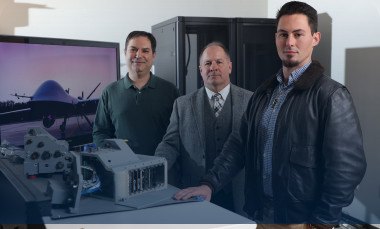
Oculus is the name for an airborne test platform under development by GTRI researchers, in collaboration with West Virginia University. Sponsored by the Department of Defense, Oculus is used for airborne testing of sensors and high-speed communications links.
Secure Collaborative Visualization Environment (SCoVE)
In June 2007, GTRI launched SCoVE—a unique environment where systems engineers, analysts and decision makers can discuss sensitive projects and view all the information associated with solutions in a highly comprehensible way.
Maintaining Air-Traffic Radio with Redesigned Modules
GTRI engineers are helping to keep air-traffic-control radios on the job until newer designs can replace them. The radios first went into service in 1968. Approximately 7,500 are still in use.
Upgrading C-130 Defensive Capability
GTRI’s integrated defensive avionics software is helping the U.S. Air Force improve the defensive electronic-warfare technology onboard some of its largest and most widely used aircraft.
GTVC: Mapping Tool Allows Emergency Management Personnel to Visually Track Resources
Tracking the location and availability of resources like hospitals, transportation equipment and water during an emergency situation can be a life-saving task. A collaborative mapping tool developed by GTRI is helping emergency management officials better coordinate incident planning and real-time response.
Georgia Tech Receives OSHA Grant to Develop Safety Training Program for Third-Shift Poultry Processing Workers
The Georgia Institute of Technology (Georgia Tech) was recently awarded a Susan Harwood Grant by the Occupational Safety and Health Administration (OSHA) to develop a comprehensive safety training program for third-shift sanitation and maintenance workers in the poultry processing industry.
Explosives on a Chip: Unique Porous Copper Structures Enable New Generation of Military Micro-detonators
GTRI scientists helped develop highly uniform copper structures that are precursors to explosives. The copper structures help improve the reliability, reduce the size and lower the cost of certain military munitions.
KaVo Dental awards state-of-the-art diagnostic instruments to GTRI in support of care for underserved/vulnerable patients
GTRI's Nickolas Faust Joins Dian Fossey Gorilla Fund International’s Board of Directors
Improving Fuel Cell Durability: Research into Better Fuel Cell Materials and Designs Starts with Studying Failures
Fuel cells can be expensive and typically don’t last as long as their internal combustion counterparts. GTRI researchers believe that understanding how and why fuel cells fail is the key to reducing their cost and improving their durability.
Clean Room Classic: Vacuum Evaporator Purchased 50 Years Ago Still Going Strong
A 1957 classic Veeco vacuum evaporator more than six feet tall and five feet wide is still in use today. Care-fully maintained and updated by GTRI engineers, the vacuum evaporator is still applying coatings in a GTRI clean room.
Car Without a Driver: Georgia Tech’s Urban Challenge Run Ends at National Qualifying Event
GTRI researchers were part of a team that designed a car that thinks for itself and requires no driver. The car, Sting 1, was entered in the Defense Advanced Research Projects Agency’s Urban Challenge competi-tion—a competitions that fosters the development of robotic ground vehicle technology.
Vision-based Screening System Detects Liner Material in Processed Foods
Food processors have long sought a method to automatically detect bits of plastic liner inadvertently mixed in with processed food. GTRI researchers have developed a prototype, vision-based screening system that fluoresces plastic liner when it is exposed to a particular wavelength of light.
Prototype Sensor under Development to Automatically Detect Chlorine Levels in Poultry Chiller Water
The amount of chlorine added to immersion chiller water to ensure microbiological safety can affect poultry product quality and taste, as well as disinfection efficiency. GTRI researchers have developed a prototype electronic sensor that can more accurately track chlorine compounds in poultry chiller water.
Repetitive Stress: Improved EWAS Takes Aim at Worker Injuries
New technology is helping position an old injury-prevention research tool developed for the poultry industry at the cutting edge of in situ biomechanical monitoring. The improved ergonomic work assessment system provides a more accurate and detailed assessment by taking advantage of new technology.
Georgia Tech Ireland Teams with IntelliOne on TrafficAid® IPTV Project
Georgia Tech Ireland is teaming up with IntelliOne Technologies on an industry-leading research and devel-opment project. The team will create an Internet Protocol Television interface for IntelliOne's TrafficAid per-sonal traffic guidance system.
New Biosensor Detects Avian Influenza Virus in Minutes, Not Days
Current methods to identify avian influenza infection in poultry can require several days to produce results. GTRI developed a new biosensor that can detect avian influenza in just minutes. The biosensor is economi-cal, field-deployable, sensitive to different viral strains and requires no labels or reagents.
Ahuja Appointed Director of Georgia Tech-Ireland
Protecting Classified Information
Tom McDermott Named GTRI Deputy Director and Director of Research
GTRI and Arthritis Foundation Offer Manufacturers Training in Product Design
Safe Water: Simpler Method for Analyzing Radium in Water Samples Cuts Testing Time
GTRI developed a new, simpler technique for testing public drinking water samples for the radioactive ele-ment, radium. The technique, approved by the U.S. Environmental Protection Agency, can dramatically re-duce the amount of time required to conduct water sampling testing.
High School Students Learn Workplace Safety
As part of an effort to increase job safety training and awareness among younger Americans, GTRI scien-tists have joined with the U.S. Occupational Safety and Health Administration and other groups to introduce health and safety training to Georgia high schools.
Widening the Wireless World
Later this year, a wireless captioning system developed at GTRI and licensed by SightLine Media will debut in movie theaters across the nation for beta testing. It will offer new, unobtrusive technology to allow people who are deaf or hard of hearing to enjoy Hollywood's latest films.
Health and Safety Sleuths: GTRI Helps Georgia Companies Improve Workplace Safety and Lower Costs
GTRI and the Georgia Tech’s Safety and Health Consultation Program helps Georgia companies improve workplace safety by identifying potential hazards and recommending solutions.
Validation and Vision: Long-term Emissions Monitoring Validates Vehicle Inspection Program and Offers Policy Insights
GTRI researchers use remote sensing equipment to monitor emissions from vehicles in the metropolitan Atlanta area. Their long-term work has validated the effectiveness of Georgia’s emissions control strategies.
Experts from GTRI's Occupational Safety and Health Program Offer Safety Tips for "Weekend Warriors"
Reducing occupational hazards remains a challenge for U.S. employers, especially for smaller companies with fewer resources. In response, GTRI helps provide technical expertise and training to help Georgia companies create cleaner, safer environments for their workers.
3D Solar Cells Boost Efficiency
Unique, three-dimensional solar cells that capture nearly all of the light that strikes them could boost the efficiency of photovoltaic systems while reducing their size, weight and mechanical complexity. The cells could find near-term applications for powering spacecraft and much more.
A Stronger Warning: Researchers Patent Digital Process for Aircraft Radar Warning Receivers
GTRI researchers have patented a discovery that could significantly increase reliability and reduce cost in equipment that helps protect U.S. military aircraft from attack. The patent covers a device called a digital crystal video receiver.
Pavement Marking: Automated System Installs Pavement Markers, Improving Safety for Road Crews and Drivers
GTRI developed a first-of-its-kind system that automatically places reflective raised pavement markers along the lane stripes of Georgia highways. The automated system is less labor-intensive, faster, safer, uses less fuel and causes less wear and tear on equipment.
Accessibility Analysis: Product Usability Improvements for People with Disabilities
GTRI’s Accessibility Evaluation Facility assesses a variety of products based on the requirements outlined in Section 508 of the federal Rehabilitation Act. Beyond evaluation, however, the researchers can recommend improvements to the products based on the concept of universal design.