GTRI

Case Study

Video Teleconferencing: Direct to Discovery Project Launched in Rahan, Ireland

Published: October 4, 2010


Click for article gallery (2 images).

Utilizing the power of high-speed networks and high-definition video teleconferencing technologies, researchers at the Georgia Tech Research Institute (GTRI) in Atlanta are working remotely with K-12 students and teachers on an exciting science collaboration. 

But this project is unlike any of GTRI's many previous educational efforts –these students attend the Killina Presentation Secondary School in the village of Rahan, County Offaly, Ireland.

Called Direct to Discovery (D2D), this program focuses on the STEM disciplines – science, technology, engineering and mathematics – by connecting classrooms at the Killina school directly to researchers at GTRI and on the Georgia Tech faculty. The D2D program is already active in the United States at schools in Barrow, DeKalb, Ware and Hall counties in Georgia, as well as at several schools in California.

"As always, our goal is to provide students with innovative education in the STEM disciplines," said GTRI researcher Jessica Pater. 

GTRI researcher Leslie Smee added that "by using today’s powerful communications tools, we can work in real time with students in Ireland and connect them to world-class research in such areas as nanotechnology, biotechnology and astronomy.”

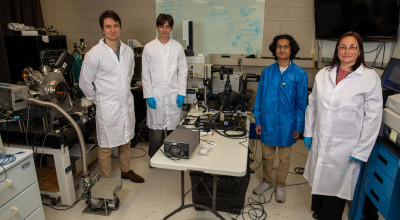
The D2D effort utilizes sophisticated, high-definition videoconferencing technologies that let students interact with researchers as if they were in the same room. For example, the young Irish scholars will participate in realistic question-and-answer sessions with far-off researchers.  In some cases, students will be able to remotely control high-level Georgia Tech equipment -- such as powerful electron-scanning microscopes and vacuum thermal evaporators used in the synthesis of carbon nanotubes.

The project is being facilitated by GTRI; by Atlantic Corridor, a development agency based in Ireland's Midlands area, and by NIS, an information technology services company also based in the Midlands area.   Rahan, County Offaly -- the village that is home to the Killina school -- is also located in the Irish Midlands, the nation's geographical center.

Killina Presentation Secondary School was one of 75 schools selected to take part in the 100Mpbs Post Primary Schools Project, an effort launched by the Irish government to deliver high-speed broadband connectivity to schools across the country. It was this 100Mbps Internet connection that enabled the Killina school to pursue the D2D project with Georgia Tech.

The D2D program is aimed at helping to address several issues within Ireland's schools, including the need to increase student interest in science and technology careers, a lack of digital content tied to curricular standards, teachers instructing outside their fields, outdated textbooks, and economic pressures that reduce possibilities for learning outside the classroom.

A recent launch of the D2D project took place in real time via a live video linkup between Rahan and Atlanta, and included a tour of Georgia Tech laboratories. During the launch, Brian Cowen -- Ireland's "Taoiseach" or head of the national government -- congratulated Atlantic Corridor “not only for this project but for all the other excellent work they are doing to promote and develop the Midlands.”

Cowen also paid tribute to teachers and students at Killina Presentation School for offering an “innovative and meaningful way of learning science ... which will inspire new ambitions and open up new avenues of study that will lead students into interesting and rewarding careers.”

At the launch, John Flanagan, Atlantic Corridor's chairman, said, “Atlantic Corridor is delighted to have fostered this project, the first of its kind in Ireland, providing valuable education beyond the bandwidth barrier. We welcome this important and innovative collaboration between Georgia Tech, NIS, Killina schools and ourselves, which will provide rich and exciting science learning experiences for the students involved.”

Michael Nolan, principal of Killina Presentation School, said, "We are all aware of the importance of science in education, and we are confident that our participation in this link to Georgia Tech will create a greater interest in science and science-based careers among our students."

Also speaking at the launch were Paul Gleeson, of the Irish Department of Foreign Affairs, who is based at the new Irish Consulate in Atlanta; Ron Hutchins, Georgia Tech's chief technology officer; and Claudia Huff and Jud Ready of GTRI.  The Atlanta consulate is part of a new strategy for Ireland-U.S. relations launched by the Taoiseach last year.

Atlantic Corridor has established a strong relationship with Georgia through its work with the Ireland-U.S. Chamber of Commerce and Georgia Tech.  The link to Killina Presentation Secondary School is part of Atlantic Corridor’s work to develop international links for science and technology education in the Irish Midlands.

Classes taught by the Killina Presentation School and GTRI began in mid-September 2010.  Students were instructed on how to use Georgia Tech equipment, and they were also introduced to research taking place at Georgia Tech.