Recent incidences of contaminated meat in grocery stores and restaurants have heightened consumer concern. But people who eat meat may rest easier if a new bacterial-sensing device being field tested this winter delivers the accurate and speedy results, plus the low costs its developers predict.
The device, called a biosensor, was developed at the Georgia Tech Research Institute (GTRI). It can simultaneously identify species and determine concentrations of multiple pathogens — including the deadly E. coli 0157:H7 and Salmonella — in food products in less than two hours while operating on a processing plant floor.
"The most significant advantage of the biosensor is the time reduction in assessing the presence of contamination," says Nile Hartman, a biosensor developer and senior research engineer at GTRI.
Lab tests for E. coli and Salmonella in meat are required by federal regulators, but there are no standards for bacterial concentration. Most companies perform laboratory tests, but they are costly and slow — sometimes not even yielding results for 48 to 72 hours. That delay requires that food products remain stored in warehouses for longer periods.
"The biosensor will help in overall quality control in food processing plants," says collaborator Dr. Paul Edmonds, a professor of biology at Georgia Tech. "It would minimize the chance of the final product being contaminated."
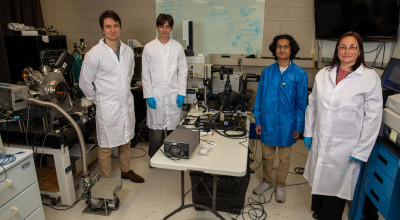
Georgia Tech researchers — in collaboration with Dr. Robert Brackett, a professor at the University of Georgia's Center for Food Safety and Quality Enhancement in Griffin, Ga. — have been developing and testing the biosensor in their laboratories for about four years. Recently, they began a field test at Gold Kist in Carrollton, Ga., just west of Atlanta.
Laboratory tests have proven the biosensor is extremely sensitive, meaning it can detect pathogens at minute levels of 500 cells per milliliter. Researchers believe they can improve that sensitivity to 100 cells per milliliter. Current laboratory methods only achieve sensitivity levels of 5,000 cells per milliliter, and they usually take from eight to 24 hours to yield results. In addition, lab equipment costs $12,000 to $20,000 per instrument compared to an estimated $1,000 to $5,000 for a biosensor.
But before the biosensor gains market acceptance, it must prove its effectiveness in the field test. The first phase will last three to six months, and researchers will compare their biosensor test results with the company's lab findings.
"One of the things we will be looking at is reproducability of results," Hartman says. "We will split a sample for testing with both of the technologies (the biosensor and lab tests). For every 1,000 tests we do, we will look for the variation between results of the two methods."
The biosensor can simultaneously detect 12 different pathogens, but researchers are concentrating on six bacterial species for now. They are Salmonella, E. coli 0157:H7, generic E. coli, Listeria monocytogenes, Campylobacter jejuni and Yersenia enterocolitica (found primarily in red meat). All of these pathogens are associated with stomach illness in humans. When detected, they are usually found in meat, but sometimes they occur in produce.
The biosensor operates with three primary components — integrated optics, immunoassay techniques and surface chemistry tests. It indirectly detects pathogens by combining immunoassays with a chemical-sensing scheme. In the immunoassay, a series of antibodies selectively recognize target bacteria. The "capture" antibody is bound to the biosensor and captures the target bacteria as it passes nearby. A set of "reporter" antibodies, which bind with the same target pathogen, contains the enzyme urease, which breaks down urea that is then added and subsequently produces ammonia. The chemical sensor detects the ammonia, affecting the optical properties of the sensor and signaling changes in transmitted laser light. These changes reveal both the presence and concentration of specific pathogens in a sample at extremely minute levels.
"If pathogens are found with the biosensor, then food processors can make decisions more quickly about applying treatments, such as antiseptics," Edmonds says. "Or they might divert those products to cooking operations, which would kill the pathogens. And companies could modify their sanitation plans."
The integrated optic interferometric sensor technology upon which the biosensor is based has already been patented by Hartman and the Georgia Tech Research Corporation. But commercialization for the biosensor is still some time away, researchers say. After the field test at Gold Kist is completed, researchers plan to return to their laboratories to further refine the technology.