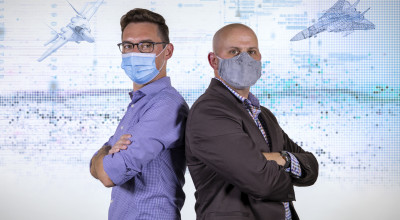
The Georgia Institute of Technology (Georgia Tech) has appointed Tommer Ender, Ph.D., the interim director of the Georgia Tech Research Institute (GTRI) and Senior Vice President for Georgia Tech. As the interim Director of GTRI, Ender leads over 3,000 employees conducting nearly $1 billion in research across a variety of disciplines, including autonomous systems, cybersecurity, electromagnetics, electronic warfare, modeling and simulation, sensors, systems engineering, test and evaluation, and threat systems. GTRI's renowned researchers combine science, engineering, economics, policy and technical expertise to address challenges facing national security, state, and industry. As interim Senior Vice President of Georgia Tech, Ender serves on the President’s Cabinet setting operational and strategic direction for the Institute.
Ender has nearly 25 years of experience focused on national security and systems engineering research. He most recently served as GTRI’s Deputy Director for Research, leading the Electronics, Optics, and Systems Directorate (EOSD). He managed operations for an 800-person unit with an annual $300 million research portfolio across three research laboratories. In this role, he also served on the GTRI Executive Council, helping set GTRI strategy and informing critical decisions impacting the organization. Ender also previously served as the Director of GTRI’s Electronic Systems (ELSYS) Laboratory, which has over 500 personnel across 12 locations in the United States and an annual sponsor award range of $165 - $250 million. ELSYS aims to be GTRI’s leading laboratory, excelling in total lifecycle systems engineering and the transition of technology into operational use.
Ender’s personal area of research includes development of collaborative, executable Model Based Systems Engineering (MBSE) tools utilizing multidisciplinary design optimization and trade space analytics applied to complex problems. He has also served as an instructor and course developer for Georgia Tech’s Professional Master’s in Applied Systems Engineering, and has served on doctoral and master’s thesis committees at Georgia Tech and other universities.
Ender has been invited to participate in a number of national committees, including at the National Academies of Science, Engineering and Medicine, offering up his expertise in the areas of systems and digital engineering. He is a certified Project Management Professional (PMP) and Certified Systems Engineering Professional (CSEP). Ender is also a Senior Member of the Institute of Electrical and Electronics Engineers (IEEE), and an active member of the International Council on Systems Engineers (INCOSE), National Defense Industrial Association (NDIA), and Military Operations Research Society (MORS), regularly publishing with those organizations.
Ender earned his bachelor’s, master’s and doctorate degrees in Aerospace Engineering from the Georgia Institute of Technology.

Related News