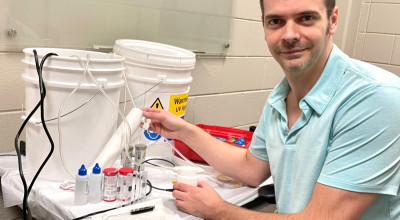
The Georgia Tech Rugby Club has been competing since 1975. It hasn't reached anywhere near the popularity of major sports such as football, basketball, baseball, and volleyball. However, each season, a team of Yellow Jacket students "scrum," "tackle," and score "tries" simply for the love of the game.
The Club depends largely on donations from supporters. One major supporter works for GTRI.
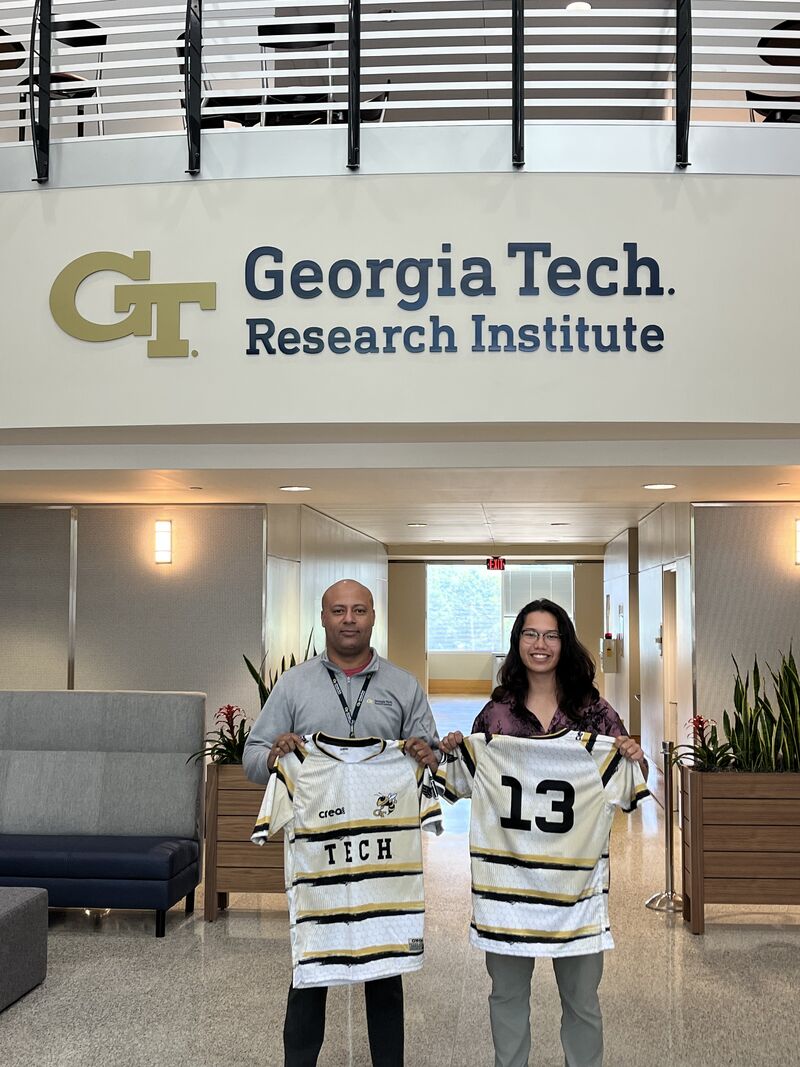
GTRI Operations Manager Rafael (Rafa) Dominguez also loves the game. Even as he advanced through his professional career (and before that, extensive experience in the U.S. Army), Rafa's love of rugby led him to assume leadership positions in rugby federations in the Dominican Republic. Being at GTRI put him in proximity to the Georgia Tech Rugby Club.
Rafa recently donated new uniforms to the club. He made the "pass" to Joshua Kinoshita, a Georgia Tech music major who is also president of the Georgia Tech Men's Rugby Club, recently at GTRI Headquarters.
Rafa said that the donation was the result of "me being a rugby enthusiast and noticing that the Tech team did not have adequate playing equipment."
Rafa likes how the Rugby Club continues to work at the grueling sport, even without great fanfare.
"At GTRI, we’re committed to supporting our broader Georgia Tech community — on and off the field. It’s inspiring to see the dedication, teamwork, and spirit these student-athletes bring to the game, and we’re proud to help them represent Tech in style.
"Wishing the team a successful season — Go Jackets!"
The Georgia Tech Men's Rugby Club's summer season began May 12. They practice Mondays and Wednesdays from 6-8 p.m. at Stamps Field (750 Ferst Drive, Atlanta, Georgia). For more information on the club, tournaments, etc., connect with them on their Instagram page, @gtrugby.
Writer: Christopher Weems
GTRI Communications
Georgia Tech Research Institute
Atlanta, Georgia
The Georgia Tech Research Institute (GTRI) is the nonprofit, applied research division of the Georgia Institute of Technology (Georgia Tech). Founded in 1934 as the Engineering Experiment Station, GTRI has grown to more than 3,000 employees, supporting eight laboratories in over 20 locations around the country and performing more than $919 million of problem-solving research annually for government and industry. GTRI's renowned researchers combine science, engineering, economics, policy, and technical expertise to solve complex problems for the U.S. federal government, state, and industry.

Related News