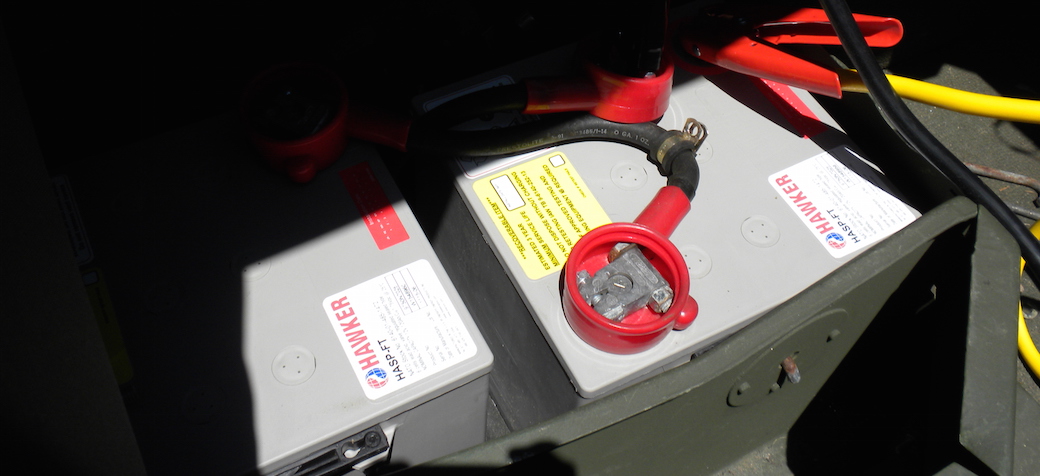
The Georgia Tech Research Institute (GTRI) was tasked by the U.S. Marine Corps Systems Command (MCSC) to compare the performance of currently used models of lead acid batteries and a new lithium ion (SCiBTMTM) chemistry battery developed by Toshiba Corp. as part of the MCSC desire to transition to efficient and renewable energy systems. The SCiBTM is a highly stable and safe Lithium Ion battery which provided significant advantages in longevity, capacity, rapid recharging, and high charge and discharge rates.
The recently completed comparison test provided several key findings, including:
- The SCiBTM can effectively start an M998 High Mobility Multipurpose Wheeled Vehicle (HMMWV).
- One SCiBTM battery replaces two lead acid batteries for a total weight savings of 116 pounds.
- SCiBTM can deep cycle discharge and rapidly recharge without any adverse impact on its capacity or ability to maintain a complete state of charge.
- When under stressful start and stop conditions the SCiBTM battery is able to start the vehicle more times than the lead acid battery and would be less likely to leave Marines stranded with a dead battery.
“These outcomes support the effort to increase combat effectiveness and reduce the Marine Corps’ need for logistics support ashore,” said Michael O’Neal, MCSC, Systems Engineering, Interoperability, Architectures and Technology (SIAT), Modeling and Simulation Lead. “Based on the Phase I results, we anticipate this new battery chemistry will help achieve the goals issued by the U.S. Marine Corps Expeditionary Energy Strategy Implementation Planning Guidance.”
The MCSC is using the comparison results to develop future plans, which may include incorporating the use of Li-Ion batteries in the Amphibious Combat Vehicle (ACV) trade space analysis, investigating the use of Li-Ion in Marine Air Ground Task Force (MAGTF) operations and conducting silent watch and cold weather testing, investigating the use of Li-Ion batteries in range test equipment, and conducting a logistics support analysis for use of Li-Ion batteries.

Related News