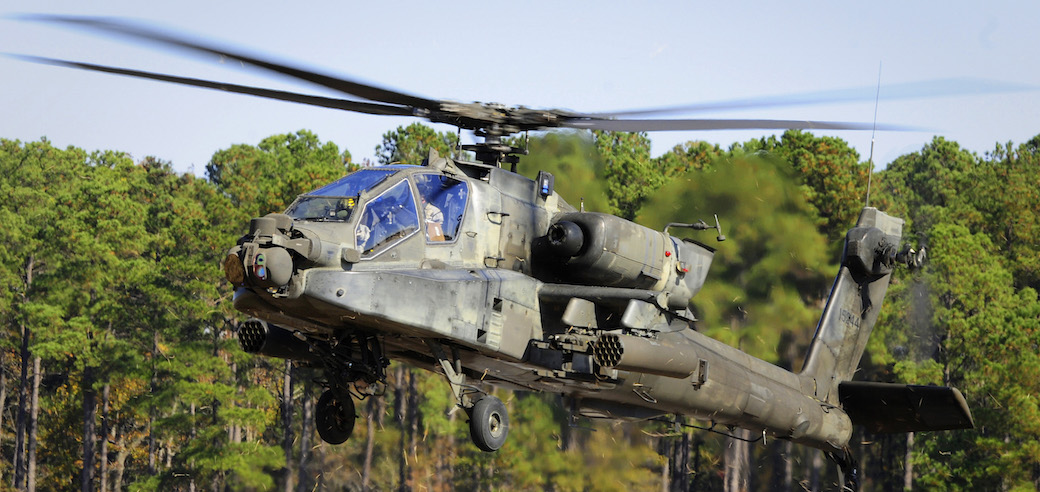
When the U.S. Army updates the defensive and offensive software on its UH60M Black Hawk and AH64D Apache helicopters, the improved systems must be fully tested to make sure they’re working properly. That includes evaluating how information is represented on the multi-function display (MFD) and multi-purpose display (MPD), which use symbology to display threats to aviation platforms.
Until recently, that testing required the use of a real helicopter or costly display components that must be configured to operate in a laboratory environment. Thanks to an MFD/MPD emulator developed by the Georgia Tech Research Institute (GTRI) in collaboration with the Army Reprogramming Analysis Team (ARAT), the testing can now be done on ordinary laboratory computers anytime it is needed. The new emulator saves a significant amount of money and can help get software updates to deployed Army aviation forces faster.
“This is an exact replica of what’s on the helicopter, so when they’re testing the software upgrades in the laboratory, they see exactly what the pilot is going to see in the helicopter cockpit,” said William Miller, a GTRI principal research scientists who helped lead the project. “When the final software for the electronic warfare system is deployed to the field, it is already tested with the display. That saves money and time.”
The project began with two days of observation into the operation of a multi-function display in operational helicopters at Dobbins Air Reserve Base north of Atlanta and Redstone Arsenal in Alabama. GTRI engineers watched as the pilots put the Aviation Survivability Equipment (ASE) through all its operations and recorded what happened on video.
Next, a development team led by GTRI Research Scientist Heyward Adams began developing the emulator in a standard military Windows-based computer, using cards to simulate the sensors that would normally be providing data to the MFD. The emulator plugs into the aircraft’s 1553 bus, and can simulate inputs from two radar warning receivers: the AN/APR 39A(V)1/4 and AN/APR 48A .
Though the lab-based computer isn’t flight-worthy, it provides the exact look-and-feel of the Apache and Black Hawk EW systems so Army mission software developers can make sure the graphical elements are clear and correct.
“We ingest the data that’s coming out of the cards just like the real hardware would in the helicopter and represent it accurately,” Adams said. “The graphics we generate provide the exact look and feel, which we showed to pilots of the helicopter to make sure we were accurate.”
The emulator is already in use by Army mission software developers in the ARAT laboratories in Aberdeen Proving Ground, MD. The GTRI researchers say the system could be easily adapted to other aircraft.
“The framework we used to develop the emulator is scalable, so it’s not tied to just one specific multi-function display,” Adams said. “Our system is set up in such a way that we could quickly and cost-effectively emulate other systems, or even an entire cockpit.”
The ASE tracks threats such as surface-to-air missiles. Because the helicopters fly at low altitudes, there’s little time to react, and no time for errors. Most threats are handled automatically, but the crew needs to know what is happening at all times.
“For pilots flying these helicopters, this is a primary display for all the threat information they are encountering,” said Miller. “This is their lifeline, and pilots have to be confident that the system will work right every time.”

Related News
In August this year, the Defense Advanced Research Projects Agency (DARPA) kicked off a virtual showdown between eight research teams from around the United States. The teams pitted their artificial intelligence (AI) algorithms against each other in a combat maneuver demonstration, formally known as the 2020 AlphaDogfight Trials.