For Georgia Tech Research Institute (GTRI), a field office can be a single person who shows up, listens, builds trust, translates between communities, and makes sure the right technical expertise reaches the right stakeholders at the right time.
That person for all of Europe is Jeremy Flight. Based in the (Wiesbaden) Field Presence, Flight serves as GTRI’s “trusted agent,” embedded with U.S. Army Europe and Africa (USAREUR-AF) headquarters, and connected daily to researchers and program teams across GTRI’s entire enterprise.
“The Wiesbaden office consists of me,” Flight said, describing a role that is intentionally lean but strategically placed. “I spend a significant portion of time at the U.S. Army Europe and Africa headquarters. So, I have an office space there. I spend most of my time there.”
That physical proximity matters. Wiesbaden is one of the places where the operational cadence of Europe’s security environment is visible. Flight is often in the room, figuratively or literally, where commanders and planners work through key military and geopolitical issues.
Flight’s job, as he puts it, starts with presence and ends with connection. He is not in Germany to be a distant representative. He is there to be useful in real time, for both the military organizations he supports and for GTRI as it seeks the clearest picture of what the warfighter needs next.
“Presence matters because, again, job number one, be a trusted agent,” said Flight. “I don’t think a person could ever become a truly trusted agent, virtually. You need to show that you’re willing to work as hard and as long as everybody else. You have to be there to answer the questions. When the boss walks out the door and says, ‘Hey, you know what’s going on with X,’ you’ve got to be able to answer the question. Nobody wants to wait.
“There are other presences in the headquarters, other UARCs [University-Affiliated Research Centers], other FFRDCs [Federally Funded Research and Development Centers],” he said. “If they’re there all the time, they’re seen, they’re noticed. And if you’re not there, then you’re not seen, you’re not noticed.”
Flight’s mission is to make sure GTRI is seen and, more importantly, trusted as a problem-solving partner. He describes his work through four core responsibilities: becoming that trusted agent, identifying opportunities where GTRI capabilities can support the mission, helping enable sponsored work when it makes sense, and serving as the interface between military headquarters and GTRI’s laboratories.
"At GTRI, I work for a company that's full of scientists and engineers. I am not smarter than them, so there's a lot of things I can learn from them. It's being able to leverage their ideas. And conversely, there are some things they can learn from me. They might have a lot of experience in radars, but do they have any experience in applying that theory in an operational environment?" he explained. "So it's just building that partnership, building that trust with folks, being empathetic, and creating a collaborative environment so that they actually want to work with you, they actually want to do the work that they're doing."

Flight started at GTRI in April 2024. Prior to that, he served 24 years in the U.S. Army.
"I was enlisted first and then commissioned as an infantry officer, and that's where I spent most of my time as an infantry officer. I've been stationed at several locations, both overseas and in the continental United States," he said. "You know, served in every echelon, from tactical platoon leader level up to the operational four-star level as a future plans chief. I have been in both Iraq and Afghanistan. I felt like I've accomplished everything I wanted to accomplish, and wanted to try something new. That's why I started working at Georgia Tech Research Institute."
Flight's experience and skills as both a soldier and a researcher are brought to bear in his current role.

Being a liaison is key to ensuring momentum is protected. Flight spends time translating operational language into technical language, and just as often, translating technical realities back into operational terms. In that translation duty, he sees himself as an ambassador rather than a developer.
“I’m here as an ambassador,” Flight said. “While hands-on coding isn't my specific skillset, I see it as my responsibility to accurately represent the deep technical mastery of our GTRI engineers. They're the ones with the specialized expertise, and my job is to make sure it gets to where it's needed most."
Even so, he has deliberately built technical fluency to better represent GTRI in high-level conversations. “There are lots of great people back at GTRI that have given me a lot of their time to give me ‘master’s classes’ on technical aspects of on modeling and simulation to at least learn the language,” he said. “So I can get into a room by myself and speak the language.”
That combination of operational credibility and technical literacy is central to the Wiesbaden presence, especially when Flight is coordinating across multiple commands and services.

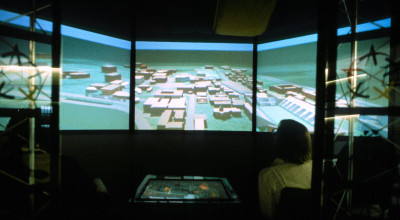
“What I’m doing here now is leading a modeling and simulation initiative to validate the capabilities required for the Eastern Flank Deterrence Line,” he said. “As a result of that, I have to talk to U.S. Air Forces Europe and Africa, I have to talk to United States European Command (EUCOM). I have to talk to the Special Operations Command Europe. I have to kind of help pull all that together.”
Then he added a line that captures the scale of the work. “You’ve got to remember that I am working a whole continent here.”
In Wiesbaden, Flight also is also within reach of a broader set of national security activities in Germany and across Europe. In 2025, for example, the city hosted the inaugural LANDEURO conference, bringing together senior leaders, industry, and partners to discuss land power in Europe and modernization priorities. Last month, U.S. Army Europe and Africa held the first “Best Drone Warfighter Competition” a few hours’ drive away in Grafenwöhr, Germany. Wiesbaden is also the headquarters for NATO’s Security Assistance and Training for Ukraine, which coordinates allied military support for Ukraine. For Flight, those are reminders that strategic planning, coalition coordination, and modernization conversations are not abstractions in this theater. They are his daily work.
In Flight’s view, that swirl of activity reinforces why in-person engagement is not a nice-to-have. It is the mechanism by which trust gets built, and relationships are cultivated.
“There’s something to be said about calling a colleague of mine down at EUCOM: ‘Hey, You want to have a meeting, I’ll be down there tomorrow,’” he said. “There’s just something about that human interaction. Face to face, where we can talk off the record about things. People are less prone to do that virtually than in person.”
His days reflect that cadence. “Big picture, my days are pretty standard,” he said. “I wake up, I go to one office, do work there, come to my home office, and do work here.”
Even within that routine, the job can pivot quickly. “Things change,” Flight said. “A senior leader might want a brief all of a sudden, right now. You’ve got to quickly prepare for that.”

"But the more meaningful advantage is informational. I'm in the fortunate position of having visibility into both sides of the equation. I get to stay current with the fantastic research and capabilities developing at GTRI, while also being deeply involved in the day-to-day operational needs here. That's a perspective I'm grateful for, and it's essential for the mission."
Asked about the long-term relevance of Europe as a theater, Flight offered an answer rooted in both geopolitics and in the enduring reality of land warfare.
“This is Jeremy talking,” he said, stressing that he was speaking from personal perspective rather than on behalf of an organization. “I think Europe will remain a relevant theater. Europe is where large-scale ground combat operations are going to happen. And why is that important? Because who does ground combat operations? The Army. And who is the Army’s largest UARC? Georgia Tech Research Institute.”
Flight’s personal story is part of what makes the Wiesbaden presence work. He served as a U.S. Army officer in Germany and later returned to the region in a civilian capacity. He described how a professional relationship became a pathway to his current role.
Presence is also what allows Flight to pick up the texture of warfighter needs before they are fully written down as requirements. One idea he returns to is the moral and operational case for reducing risk to soldiers by shifting the most dangerous tasks to machines.
"With the growth of AI, the growth of remotely operated capabilities, ground, air, and maritime, there’s a realization that machines, AI-enabled or remotely operated, can do a lot of the work that a human could do," he said. "I don’t mean like the large-scale warfighting. There’s always going to be humans in that."
Flight has a term to describe the shift: “Trading Robots for Blood.” That concept, he said, came from a senior military leader, and it has stuck because it captures a clear goal. If a task can be done by a system rather than a soldier, especially when contact with the enemy is likely, the option deserves serious consideration.
In Flight’s experience, soldiers tend to grasp the concept quickly because they have lived the risk. Explaining the same concept to technical audiences can require a different kind of translation.
"I’ve actually found it harder to get the researchers to understand what that means than the soldiers," he said, adding that the gap is not about competence, but about language and lived context. "It’s highlighting the difference between operational speak and actual warfighting by humans. Part of my job is to translate that."
There is very much a human dimension to Flight’s story. He speaks warmly about living in a place that is home for his family, while also noting the differences Americans notice immediately.
In the end, Flight’s message to his colleagues across GTRI is straightforward: stay curious about the mission, stay connected, and do not underestimate the value of relationships.
He emphasized that even in a role defined by geography and time zones, the work is driven by regular, deliberate touch points. "It’s just a matter of getting on the phone, or getting on Slack or Webex," he said, "and having kind of routine touch points with different people across different organizations."
Flight is helping ensure that GTRI’s researchers are closer to the mission conversations that shape tomorrow’s requirements. In an era where the pace of change is accelerating, and the stakes are measured in readiness and lives, his work is a reminder that national security innovation is not built only in laboratories. It is also built in the rooms where decisions are made daily.
Writer: Christopher Weems
GTRI Communications
Georgia Tech Research Institute
Atlanta, Georgia
About the Georgia Tech Research Institute (GTRI)
The Georgia Tech Research Institute (GTRI) is the nonprofit, applied research division of the Georgia Institute of Technology (Georgia Tech). Founded in 1934 as the Engineering Experiment Station, GTRI has grown to more than 3,000 employees, supporting eight laboratories in over 20 locations around the country and performing more than $919 million of problem-solving research annually for government and industry. GTRI's renowned researchers combine science, engineering, economics, policy, and technical expertise to solve complex problems for the U.S. federal government, state, and industry.

Related News