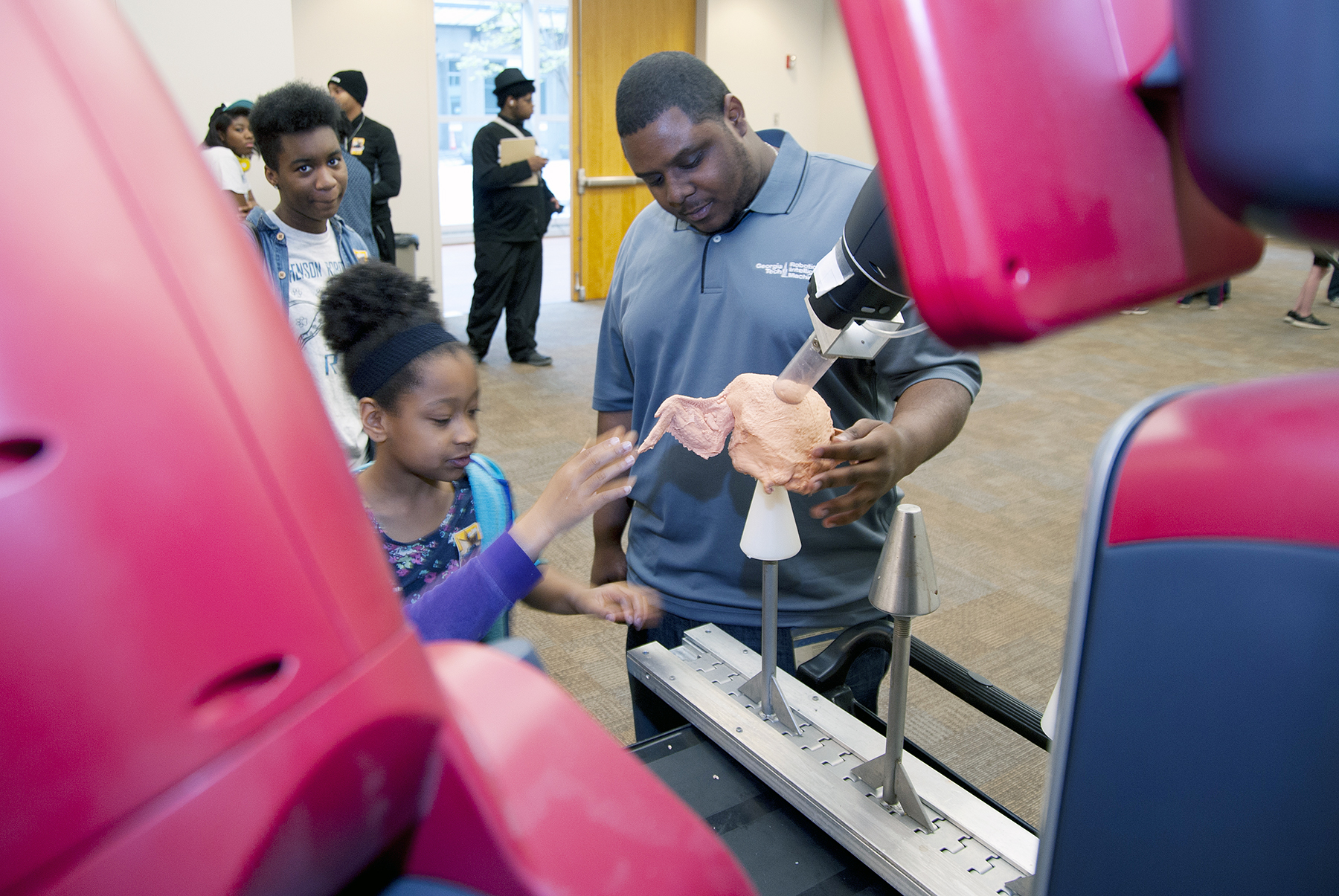
The Georgia Tech Research Institute (GTRI) hosted several high school groups as they toured Georgia Tech robotics exhibits during Georgia Tech’s Robotics Demo Day.
Roughly 200 students, employees and their children viewed the six robot demonstrations at the GTRI Conference Center. Researchers from the Aerospace, Transportation and Advanced Systems (ATAS) laboratory presented their research, which ranged from agile assembly to working with poultry and agriculture.
Researchers and their projects
-
Stephen Balakirsky, Agile Robotic Assembly
Robots demonstrate the ability to detect and understand objects in an assembly environment, create a simple assembly and detect potential errors.
-
Ai-Ping Hu, Agricultural Robotics
Robotic arms work in unstructured environments, such as chicken deboning and leaf picking.
-
Zsolt Kira, Perception Demo
Flying robot uses a camera for classification and detection.
-
Gary McMurray, Leaf Grasping
Autonomous robot collects leaves for disease inspection.
-
Sean Thomas, Automated Cone Loading
A Baxter-style robot automatically loads poultry products onto conveyor lines.
-
Colin Usher, GOHbot
The Chicken Grow-Out House Service Robot autonomously drives between two defined waypoints, avoiding stationary and mobile obstacles in its way.
“It is always important to show students interested in science and technology some of what we really do here at GTRI,” said ATAS Lab Director Rusty Roberts. “These students are able to see some of the exciting and groundbreaking work that scientists and researchers do.”
Nearly 40 groups with as many as 60 students to as few as five attended some of the demonstrations located around the campus. Roughly 20 projects on Georgia Tech’s campus greeted the students on April 1, 2016, in celebration of National Robotics Week.

Related News
Quantum computers are in theory capable of simulating the interactions of molecules at a level of detail far beyond the capabilities of even the largest supercomputers today. Such simulations could revolutionize chemistry, biology and materials science, but the development of quantum computers has been limited by the ability to increase the number of quantum bits, or qubits, that encode, store and access large amounts of data.
Students from nine metro Atlanta middle schools deployed their underwater remotely operated vehicles (ROV) in a competition sponsored by the Georgia Tech Research Institute (GTRI) and the U.S. Navy.