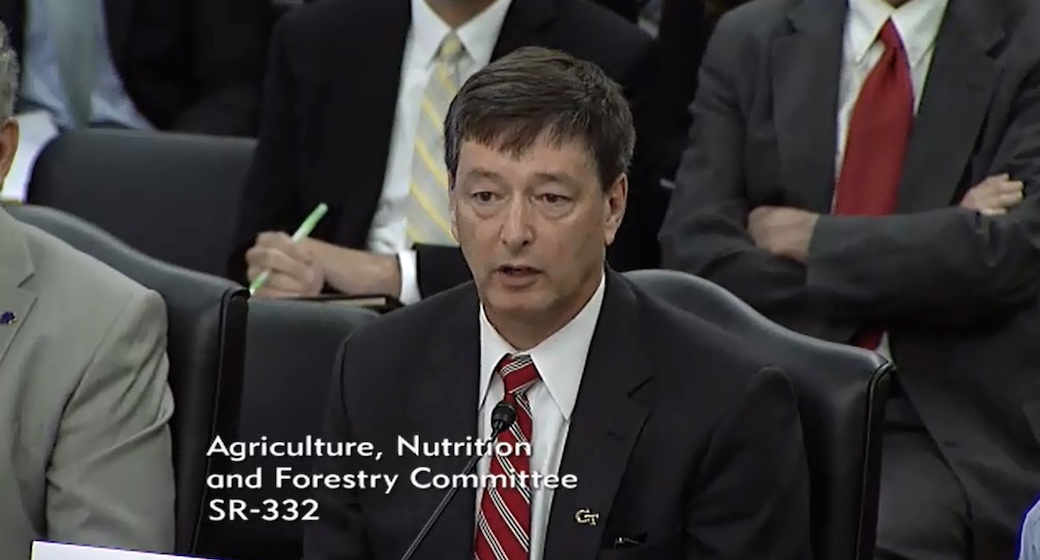
Gary McMurray testified before a Congressional committee Thursday, offering expert testimony on the importance of agricultural funding, research and innovation.
McMurray leads the Food Processing Technology Division at the Georgia Tech Research Institute. He also develops advanced robotic systems for the food, transportation and biomedical industries.
He spoke before the Senate Committee on Agricultural, Nutrition and Forestry during a hearing titled “Agricultural Research: Perspectives on Past and Future Success for the 2018 Farm Bill.”
McMurray stressed the critical role agricultural research plays in meeting future food production demands. While great strides have been made, he said more work must be done.
“Transformative innovation is needed,” said McMurray, who is also associate director of Georgia Tech’s Institute for Robotics and Intelligent Machines. “Transformative innovation moves beyond just improving existing methods and processes to totally re-thinking systems development by creating entirely new systems.”
He highlighted some of the work Georgia Tech is doing in conjunction with the University of Georgia to monitor crop health using autonomous systems.
For example, the institutions are developing ways for unmanned ground vehicles to work in conjunction with unmanned aerial vehicles to enable earlier detection of infected trees and plants and to identify the source of the problem so there can be more targeted intervention to prevent crop losses.
Read McMurray’s complete testimony here.

Related News